
TL;DR: A bank levy freezes an account on contact, but Florida law and federal exemptions create narrow windows to file challenges before funds transfer to the judgment creditor. The difference between a successful defense and a lost account balance often turns on whether the right motion reaches the clerk before the garnishee remits the frozen funds.
The writ arrives at the bank before the debtor knows it exists. Funds freeze at the moment of service. What happens in the days that follow, after the account is frozen but before the garnishee files its answer and the funds move, determines whether a challenge can preserve the balance or merely document its loss. For judgment creditors, this is the interval that tests whether pre-levy intelligence was accurate, whether exemptions were screened, and whether the debtor will mount a defense worth answering. The levy itself is mechanical; what matters is what gets filed before the clock runs out.

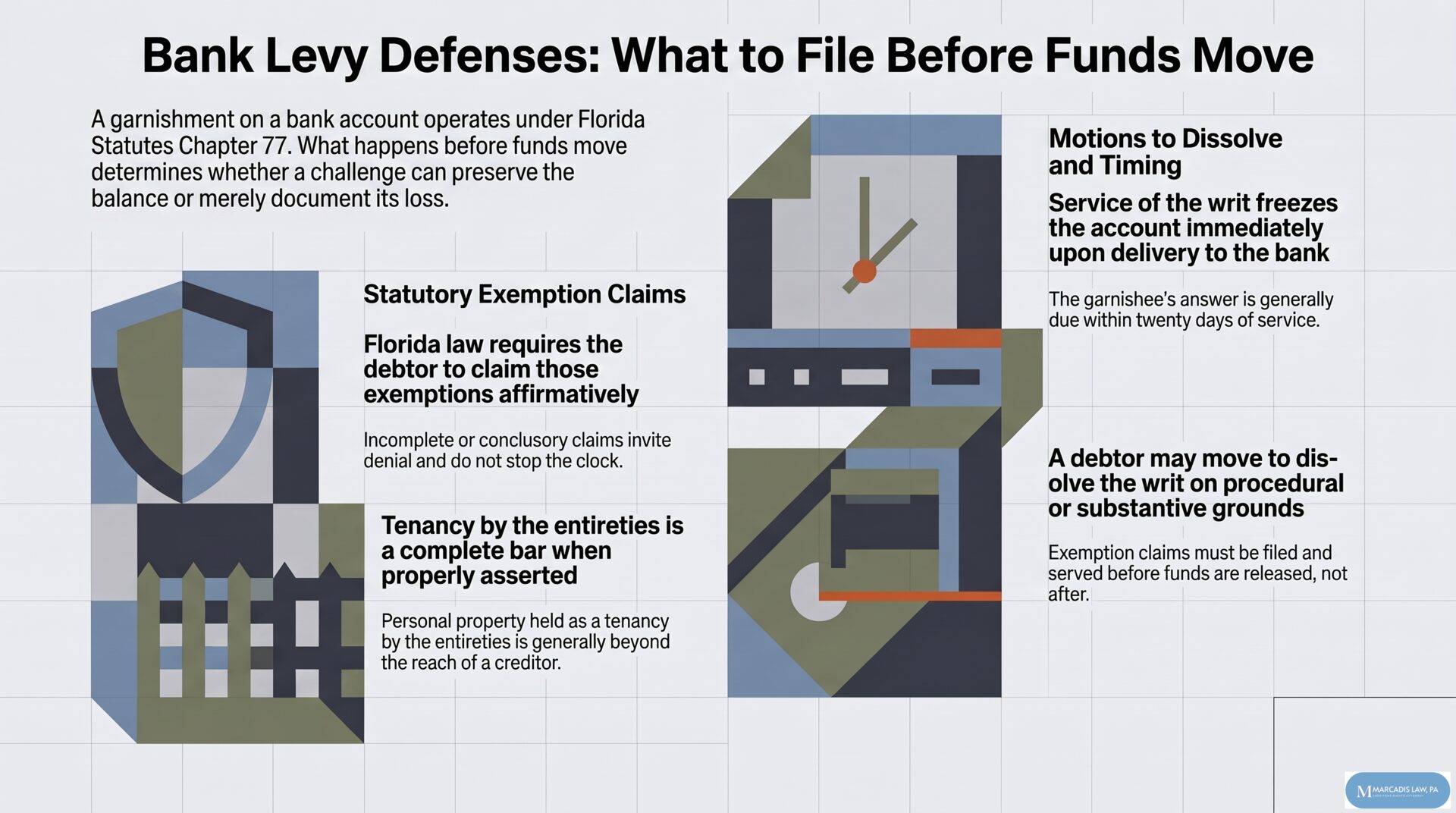
A garnishment on a bank account operates under Florida Statutes Chapter 77. The writ is served on the financial institution, which freezes the account and has a statutory window: twenty days under Fla. Stat. § 77.04, to file an answer stating what it holds. That answer triggers the next phase: absent a timely exemption claim or dissolution motion, the funds are released as the court directs and applied to the judgment. The debtor's opportunity to intervene lies in the space between service on the bank and the garnishee's answer or, more urgently, before the funds are released.
Exemption Claims: Federal and State Protections
Certain funds are exempt from levy by statute, and Florida law requires the debtor to claim those exemptions affirmatively. The burden is not on the creditor to detect them, and the bank does not screen for exempt status before freezing the account. Common exemptions include Social Security benefits, Supplemental Security Income, veterans' benefits, and Railroad Retirement benefits under federal law. Florida Statutes § 222.11 codifies head-of-household wage protections, which extend to direct-deposited earnings if the account contains wages paid within the prior six months and the debtor qualifies as head of household. Under Fla. Stat. § 77.041, the debtor's exemption claim must be filed with the court that issued the writ and served on the judgment creditor and the garnishee, generally within twenty days after the notice of garnishment is mailed or otherwise provided to the debtor.
Timing is unforgiving. If the exemption claim is filed after the funds have already been released and applied to the judgment, the claim becomes a motion to return funds already disbursed. A procedurally difficult and often unsuccessful posture. The protective window is the period after the debtor receives notice but before the funds leave the garnishee. Creditors evaluating whether to pursue a bank levy assess the likelihood that exempt funds dominate the account balance, recognizing that a late-stage exemption dispute introduces delay, cost, and potential exposure if the funds are federally protected.
What the Claim Must Include
An exemption claim is not a generalized objection. It must identify the specific statutory basis for the exemption, describe the nature and source of the funds, and attach supporting documentation where the exemption is not facially obvious. For direct-deposited Social Security benefits, the claim typically includes bank statements showing the deposits and their federal origin. For head-of-household wages, the debtor should provide an affidavit establishing dependency and a statement tracing the deposits to employment income within the six-month lookback. Incomplete or conclusory claims invite denial and do not stop the clock.
Motions to Dissolve: Procedural and Substantive Challenges
A debtor may move to dissolve the writ on procedural or substantive grounds before funds are released. Procedural defenses include improper service of the underlying judgment, lack of jurisdiction over the judgment debtor, expiration of the judgment lien or of the twenty-year life of a Florida judgment (see Fla. Stat. § 55.081), or failure to comply with the garnishment statute's notice requirements. Substantive challenges include satisfaction or partial satisfaction of the judgment, miscalculation of the balance owed, or allegations that the account is held in a form not subject to levy, such as a tenancy by the entireties account in a case involving only one spouse as judgment debtor.
These motions must be filed promptly and supported by evidence. A bare assertion of improper procedure does not by itself resolve the garnishment; when a motion to dissolve raises a proper denial of the grounds for the writ, the statute contemplates prompt judicial attention, and the court determines whether the writ stands or dissolves. Creditors watch for dissolution motions that are strategic rather than substantive, filed to create delay without a colorable legal basis. When the motion identifies a genuine defect, the creditor must evaluate whether to stipulate to a correction, oppose the motion, or withdraw and re-levy correctly.
Tenancy by the Entireties: A Complete Bar When Properly Asserted
In Florida, personal property held as a tenancy by the entireties is generally beyond the reach of a creditor holding a judgment against only one spouse. The protection is a matter of Florida common law as developed by the state's courts, and it applies to bank accounts titled in the names of both spouses where the signature card and account terms reflect entireties ownership. The exemption is not automatic in garnishment proceedings; the debtor must assert it. Once the debtor establishes that the account was opened as an entireties account, the burden shifts to the creditor to prove otherwise, for example, that the account is not entireties property or that the debt is a joint obligation of both spouses.
Creditors conducting pre-levy due diligence look for indicators that an account may be entireties property: joint titling, marriage records, and prior pleadings in which the debtor asserted marital status. If the account is likely protected, the levy may be foregone in favor of other remedies. If entireties status is asserted post-levy, the creditor must decide whether to challenge the claim, requiring proof that the account is separately titled, that the marriage is invalid or dissolved, or that the debt arose from a joint obligation, or to release the levy and pivot to non-exempt assets. A miscalculation here can expose a creditor to fee-shifting under Florida Statutes § 57.105 if the levy is pursued without a colorable basis after entireties status is evident.
The Garnishee's Role and the Creditor's Dependence on Accuracy
The bank, as garnishee, is not an advocate for either party. Its statutory duty is to freeze the account upon service, file a truthful answer within the prescribed time, and hold or remit funds as directed by the court. The garnishee does not investigate exemptions, does not determine whether the account is entireties property, and does not adjudicate the validity of the underlying judgment. Errors in the garnishee's answer, incorrect balance reporting, failure to disclose multiple accounts, or premature release of funds, may expose the garnishee to liability, but those errors do not create substantive defenses for the debtor or windfalls for the creditor.
For the judgment creditor, the garnishee's answer is the confirmation of what pre-levy asset discovery suggested. If the balance is lower than expected, the creditor must decide whether to pursue supplementary proceedings to locate additional accounts or non-exempt assets. If the garnishee reports that the account is jointly held or contains exempt deposits, the creditor evaluates whether the leverage justifies the cost of a contested hearing. The answer is not the end of the process; it is the factual foundation for what comes next.
- Service of the writ freezes the account immediately upon delivery to the bank
- The garnishee's answer is generally due within twenty days of service unless the court extends the time
- Exemption claims must be filed and served before funds are released, not after
- Tenancy by the entireties must be asserted by the debtor before the burden shifts to the creditor
- Procedural defects in service or notice may warrant dissolution but do not automatically void the levy
- Once funds are disbursed to the creditor, recovery requires a separate motion and a harder evidentiary showing
What Moves the Needle: Speed, Precision, and Record Evidence
A defense filed after the garnishee's answer but before the release of funds has a real chance. A defense filed after disbursement is an uphill motion to recover, requiring proof that the levy reached funds protected by a clear statutory exemption. Speed matters, but precision matters more. A motion that misstates the exemption statute, omits supporting affidavits, or fails to serve all parties in the manner required by the Florida Rules of Civil Procedure may be denied on procedural grounds regardless of the merits.

For creditors, the calculus is straightforward: if pre-levy asset intelligence shows that the account is likely exempt, protected by entireties ownership, or insufficient to justify the cost and risk of a contested proceeding, the levy is not pursued. If intelligence is incomplete and the levy proceeds, the creditor monitors for timely exemption claims or dissolution motions and prepares to respond with evidence that the funds are non-exempt, that entireties status does not apply, or that procedural compliance was met. The levy is a tool, not a guarantee, and its success depends on what is known before the writ is issued and what is filed before the funds move.
Closing Remarks
If asset discovery has identified a bank account but exemption risk or entireties ownership remains unresolved, if a garnishee's answer has revealed joint titling or federal benefit deposits, or if the debtor has filed an exemption claim that appears facially valid but incomplete, the window to respond or withdraw is brief. Marcadis Law Firm enforces judgments with the precision required to protect our clients' recoveries and reputations at institutional scale. Contact us to evaluate the next step while the account is still frozen.
Frequently Asked Questions
Can a creditor levy a bank account without prior notice to the debtor?
Yes. Florida garnishment law does not require advance notice to the judgment debtor before the writ is served on the bank. The account is frozen upon service to the financial institution, and the debtor typically receives the statutory notice of garnishment only after the freeze has occurred. The debtor's opportunity to challenge the levy arises after that notice, and the burden is on the debtor to act within the statutory deadlines to assert exemptions or move to dissolve the writ.
What happens if exempt funds and non-exempt funds are commingled in the same account?
Commingling does not automatically defeat an exemption, but it complicates the debtor's burden of proof. The debtor must trace the exempt funds, typically through bank statements showing the deposit source and timing, and demonstrate that a portion of the frozen balance is attributable to exempt sources such as Social Security or head-of-household wages. If tracing is incomplete, the court may allocate the balance or deny the exemption claim. Creditors scrutinize commingled accounts precisely because the evidentiary burden on the debtor increases with each additional deposit source.
How long does a garnishee have to file its answer, and can that deadline be extended?
Under Florida Statutes § 77.04, the garnishee must serve its answer within twenty days after service of the writ. The deadline may be extended by court order, typically upon motion by the garnishee showing cause such as difficulty verifying balances across multiple accounts. Extensions are not automatic, and delay in filing the answer does not extend the debtor's deadline to claim exemptions after notice. Creditors monitoring the docket watch for garnishee delays that may signal complication or dispute.
Can a creditor levy a joint account if only one account holder is the judgment debtor?
It depends on how the account is titled and the relationship between the account holders. If the account is held as a tenancy by the entireties and the judgment is against only one spouse, the account is generally beyond the creditor's reach. If the account is jointly titled but not entireties property, such as a parent-child joint account or an account shared by unmarried parties. Florida law generally permits garnishment of the debtor's interest, and the non-debtor co-owner may contest the levy and assert a claim to the funds. Creditors evaluate joint account risk before levying, as competing claims introduce delay and litigation cost even when the debtor's interest is ultimately reachable.
What recourse does a debtor have if exempt funds were released to the creditor before an exemption claim was filed?
The debtor may move for the return of the funds, arguing that they were exempt by statute and should not have been levied. The burden is on the debtor to prove the exempt status and to show that the funds were traceable to a protected source. Courts are generally less inclined to order the return of funds already disbursed, particularly if the debtor failed to act within the statutory exemption claim period. Recovery is possible but procedurally difficult, and delay works against the debtor. Creditors facing such motions evaluate whether the exemption rests on federal law, such as Social Security benefits, which are protected under 42 U.S.C. § 407, because federally protected funds carry heightened return exposure.
Does a pending bankruptcy automatically release a bank levy in Florida?
Not automatically released, but halted. The filing of a bankruptcy petition triggers an automatic stay under 11 U.S.C. § 362, which stops most collection activity, including garnishment and levy. If the writ was served and funds were frozen before the bankruptcy filing but not yet disbursed, the stay generally requires the parties to hold in place and obtain direction from the bankruptcy court, whether through a turnover proceeding, a motion to avoid the garnishment lien, or a motion for relief from stay. If funds were already disbursed to the creditor before the filing, they may be subject to turnover or preference litigation depending on the timing and circumstances. Creditors monitor for bankruptcy filings closely during the garnishee answer period for precisely this reason.
References
- Florida Statutes Chapter 77 (Garnishment).
- Fla. Stat. § 77.04 (Writ; answer of garnishee).
- Florida Statutes § 222.11 (Exemption of wages from garnishment).
- Fla. Stat. § 77.041 (Notice to individual defendant for claim of exemption from garnishment; procedure for hearing).
- Fla. Stat. § 55.081 (Statute of limitations, lien of judgment).
- Florida Statutes § 57.105 (Attorney's fee; sanctions for raising unsupported claims or defenses).
- 42 U.S.C. § 407 (Assignment of benefits).
- 11 U.S.C. § 362 (Automatic stay).