
TL;DR: Florida law protects certain wages from garnishment, including head-of-household earnings and a portion of disposable income for others. Understanding which income streams remain exempt, and which do not, determines whether wage garnishment is a viable collection tool or a wasted motion.
A judgment in hand is not the same as money in the bank. The debtor still controls the assets, still chooses which obligations to honor, and still has every incentive to delay. Wage garnishment closes that gap; it redirects earnings at the source, before the debtor sees them. But Florida builds walls around certain income, and those walls hold. What looks like a paycheck may be legally untouchable, and what appears protected may be fair game once the statutory language is read in full. The enforcement decision begins not with whether the debtor is employed, but with whether the wages can be reached at all.

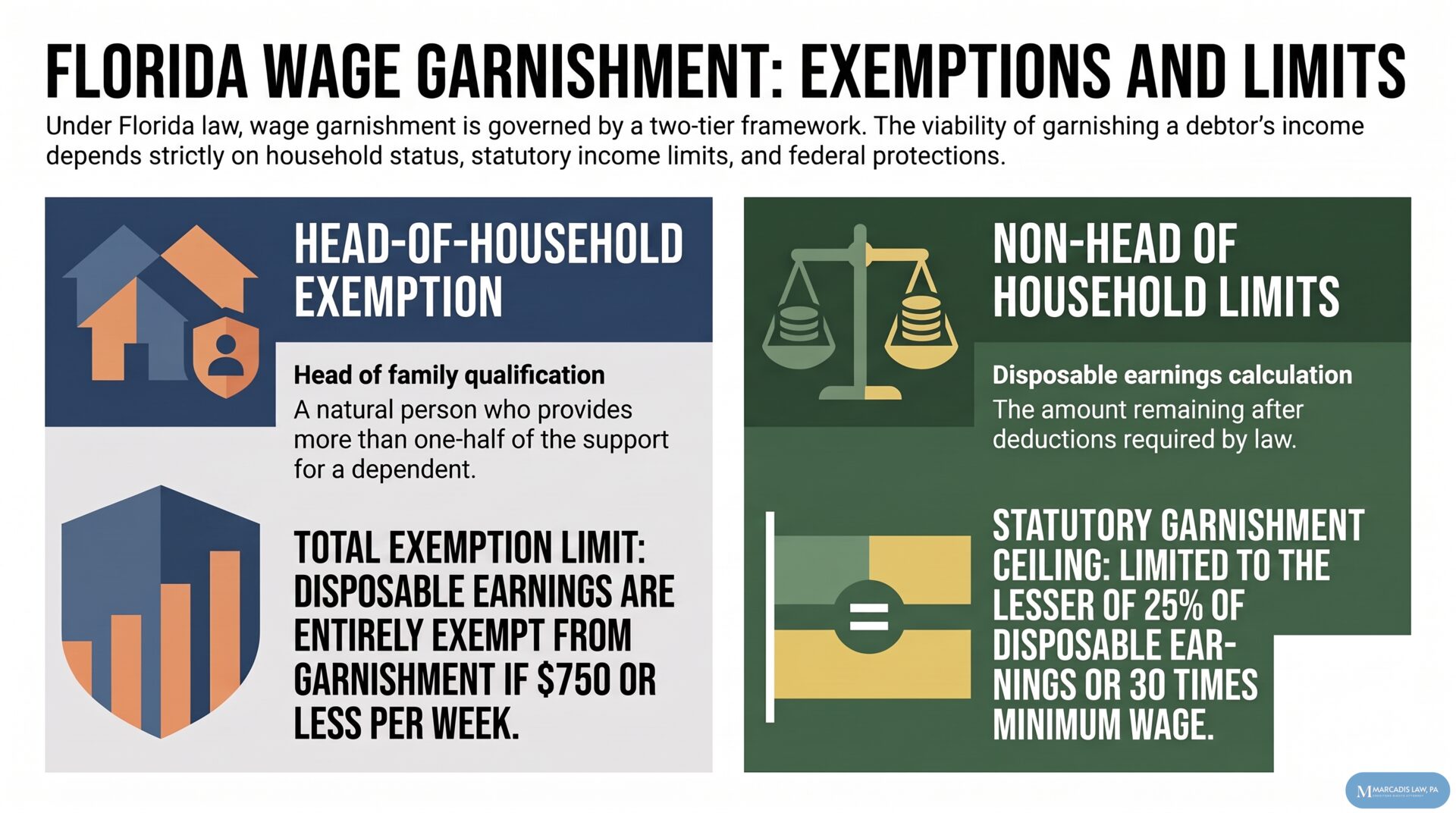
Florida Statute § 77.0305 authorizes the continuing writ of garnishment against salary or wages, and Florida Statute § 222.11 supplies the exemption that governs whether that writ will yield anything. Together they establish a two-tier structure. For debtors who qualify as head of household, wages are entirely exempt from garnishment unless the debtor agrees otherwise in writing, subject to the narrow statutory conditions. For all others, federal law limits garnishment to the lesser of 25% of disposable earnings or the amount by which weekly disposable earnings exceed 30 times the federal minimum wage. The framework is mechanical, but its application depends on facts that shift: household composition, dependents, and the source of the income itself.
Head-of-Household Exemption
The most powerful wage protection in Florida is the head-of-household exemption. Florida Statute § 222.11 defines head of family as a natural person who provides more than one-half of the support for a child or other dependent. When that threshold is met, disposable earnings are entirely exempt from garnishment if they are $750 or less per week; earnings above that figure are exempt unless the debtor has agreed otherwise in writing. That protection follows the earnings for six months after deposit into a financial institution, provided they remain traceable and identifiable as earnings.
The exemption is not automatic. The debtor must assert it, typically by filing a claim of exemption after the writ of garnishment is served. Courts evaluate the claim based on the debtor's sworn statements and supporting documentation, tax returns, custody orders, school enrollment records, and proof of financial support. A debtor who pays rent for a household in which a dependent resides and contributes substantially to food, clothing, and education will generally qualify. One who shares custody but does not provide the majority of support will not.
Creditors may contest the claim by filing a sworn denial and requesting an evidentiary hearing. The burden rests on the debtor to prove entitlement to the exemption, but once that burden is met, the protection holds. The claim is not defeated by showing that the creditor's need is greater or that the debt is large. The statute draws a clear line, and the debtor who qualifies stands behind it.
Disposable Earnings and Federal Limits
For debtors who do not qualify as head of household, wage garnishment is limited by the federal Consumer Credit Protection Act, codified at 15 U.S.C. § 1673. Florida practice observes these federal caps, which limit garnishment to the lesser of two calculations: 25% of the debtor's disposable earnings, or the amount by which disposable earnings exceed 30 times the federal minimum hourly wage in a workweek.
Disposable earnings are defined as the amount remaining after deductions required by law, federal and state income tax, Social Security, and Medicare. Voluntary deductions such as retirement contributions, health insurance premiums, and union dues are not subtracted when calculating the garnishable amount. The employer performs the calculation each pay period and withholds the permitted amount, which is then remitted as directed by the writ and applicable court procedure.
Consider a hypothetical: a debtor earns $800 per week in gross wages. After deductions required by law totaling $200, disposable earnings are $600. Twenty-five percent of $600 is $150. At a federal minimum wage of $7.25 per hour, 30 times that figure is $217.50. The amount by which $600 exceeds $217.50 is $382.50. The garnishment is capped at the lesser figure, $150 per week. The debtor retains $450, and that floor cannot be breached absent a separate support order or tax levy.
Income Sources Beyond Wages
Not all money a debtor receives is wages, and not all income enjoys the same protection. Florida law distinguishes sharply among categories, and those distinctions determine whether garnishment, or another collection remedy, applies.
- Social Security benefits: Exempt under 42 U.S.C. § 407(a). Not subject to garnishment for most consumer debts, and that exemption extends to funds deposited in a bank account, provided the account contains only exempt funds or the exempt portion can be traced.
- Unemployment compensation: Exempt under Florida Statute § 443.051(2). Not subject to garnishment except as the statute allows, including for child support obligations and repayment of prior overpayments.
- Workers' compensation: Exempt under Florida Statute § 440.22, which protects compensation payable under the chapter from creditor claims, including wage garnishment.
- Retirement accounts: Qualified ERISA plans are generally protected under federal law. Florida Statute § 222.21 extends exemption protection to IRAs and other qualified retirement plans and their proceeds.
- Independent contractor payments: Not salary or wages for purposes of the continuing writ. Amounts owed may still be reached by a one-time writ served on the payor, or by levy once deposited.
- Commissions and bonuses: Treated as earnings when paid as compensation for personal services in an employment relationship, and subject to the same exemption rules and federal limits.
The characterization exercise determines the remedy. Wages flow through continuing garnishment. Bank accounts holding non-wage funds are reached by a writ served on the financial institution. Understanding the source before filing the writ prevents wasted service fees and procedural dead ends.
Bank Account Garnishment and the Six-Month Rule
Earnings enjoy their strongest protection while in the employer's hands, and Florida Statute § 222.11 carries that protection forward for six months after the earnings are deposited into a financial institution, provided the funds remain traceable and identifiable as earnings. Once six months pass, or once commingling defeats traceability, the debtor's ability to sustain the claim narrows considerably.
For creditors pursuing creditors rights and debt collection, this creates a strategic window. A wage garnishment that fails due to head-of-household status may be followed, months later, by a writ served on the debtor's bank targeting funds that have aged out of the earnings exemption. The debtor who successfully claims exemption at the payroll stage may lose that same money at the account stage if sufficient time has passed and the funds can no longer be traced.
The burden to establish exempt status rests on the debtor. Account statements, deposit records, and documentation linking specific deposits to earnings are required. A debtor who deposits wages into an account also used for business income, gifts, or loan proceeds will struggle to meet that burden. Clean separation of funds is rare in practice, and that reality rewards creditors willing to be patient and to layer remedies in the right order.
Procedural Requirements and Employer Obligations
Wage garnishment in Florida is initiated by obtaining a writ of garnishment from the court that entered the judgment. The writ is served on the debtor's employer, who then becomes the garnishee, a third party holding money or property of the debtor that is subject to the creditor's claim. Florida Statute § 77.06 requires the garnishee to answer the writ within 20 days after service, stating whether it is indebted to the debtor, in what amount, and what other writs or claims it is aware of. Under Florida Statute § 77.041, the creditor must also serve the debtor with a claim-of-exemption form and the accompanying statutory notice.
A garnishee that fails to answer risks a default and judgment for the amount demanded, and one that pays wages over to the debtor after service of the writ may be held responsible for amounts that should have been retained. That exposure is real and enforceable by judgment against the employer, which is why most employers answer promptly even when the debtor disputes the garnishment or claims an exemption.
The debtor receives notice of the garnishment and a claim-of-exemption form, and has 20 days from service of that notice to file the claim or another defense. Filing prompts a hearing, at which the debtor must prove entitlement to the exemption by competent evidence. If no claim is filed, the garnishment proceeds without further court intervention, and the garnishee continues withholding under a continuing writ until the judgment is satisfied or the writ is dissolved.
Priority among competing claims matters. Income withholding for child support and spousal support takes precedence over general creditor garnishments. Federal tax levies generally take priority over state-court garnishments. Administrative wage garnishment for defaulted federal student loans, authorized under 20 U.S.C. § 1095a, is subject to a lower cap: 15% of disposable pay rather than 25%. It operatestes outside the state-court queue. Multiple creditors seeking the same wages must work through that queue, and late arrivals may find nothing left to withhold.

A related enforcement tool, is the post-judgment debtor examination, which can reveal not only current wages but also upcoming bonuses, commissions, and other income streams that are harder to garnish in real time. The examination and the garnishment work in tandem: one uncovers the asset, the other secures it.
Closing Remarks
If a judgment debtor is employed but claiming head-of-household status, if earnings have sat in an account long enough that the exemption claim deserves testing, or if an employer has failed to answer a writ and the judgment remains unsatisfied, the path forward requires precision, not assumption. Marcadis Law Firm represents judgment creditors across Florida in post-judgment enforcement, including wage garnishment, garnishment of financial accounts, and exemption litigation, with the same measured process on every file. Contact us to discuss your enforcement options and the next procedural step.
Frequently Asked Questions
Can a creditor garnish wages if the debtor is self-employed?
Self-employed individuals do not receive salary or wages from an employer, so a continuing writ of garnishment directed at an employer will not apply. However, amounts owed to the self-employed debtor by clients or customers may be reached by a writ served on that payor before the funds are released. Creditors may also garnish a deposit account once funds arrive, or pursue a charging order if the debtor holds an interest in a limited liability company. The remedy depends on the structure of the income stream and the timing of service.
Does the head-of-household exemption apply to independent contractors?
Florida Statute § 222.11 protects the "earnings" of a head of family, and Florida courts have applied that protection to compensation for personal labor and services even where the payer treats the debtor as an independent contractor. The analysis turns on the facts rather than the label: whether the debtor provides more than one-half of the support for a dependent, and whether the money represents compensation for the debtor's own services rather than a return on capital or business profits. A qualifying debtor may therefore assert the exemption even when payments are reported on a 1099 rather than a W-2, though the creditor is entitled to test that characterization at an evidentiary hearing.
What happens if a debtor has multiple garnishments from different creditors?
Federal law caps the total amount that may be garnished for ordinary judgment debts at 25% of disposable earnings, regardless of how many creditors are pursuing collection. Where multiple writs reach the same employer, the garnishee must account for them in its answer, and the court determines the order and allocation of payment within the statutory ceiling. Income withholding for child support and spousal support takes priority over general creditor garnishments, and federal tax levies generally take precedence over state-court writs. A creditor whose writ arrives late may recover nothing if prior claims consume the available garnishable amount.
Can a creditor garnish wages if the debtor lives in Florida but works in another state?
Garnishment reaches the employer, so the practical question is where the employer can be served and which state's law governs the withholding. If the debtor resides in Florida but the employer has no presence subject to Florida jurisdiction, the creditor will generally need to domesticate the Florida judgment in the state where the employer is located and proceed under that state's garnishment procedures and exemptions, which may be broader or narrower than Florida's. That route adds time and expense, but it is often the only way to reach out-of-state wages. Counsel licensed in that state should evaluate its requirements.
How long does a wage garnishment remain in effect?
A continuing writ of garnishment against salary or wages remains in effect until the judgment is satisfied in full, the writ is dissolved by court order, the debtor's employment with the garnishee ends, or the garnishee is otherwise released. In practice, most writs continue for as long as the debtor remains employed by that garnishee and no successful exemption claim is filed. If the debtor changes jobs, the creditor must obtain and serve a new writ on the new employer. There is no automatic transfer of garnishment from one employer to another, and gaps in employment create gaps in collection.
Does filing bankruptcy stop wage garnishment?
Yes. Filing a bankruptcy petition triggers an automatic stay under 11 U.S.C. § 362, which halts most collection activity, including wage garnishment. The employer should cease withholding on behalf of the judgment creditor once it receives notice of the filing. The stay remains in effect until the court grants relief from stay, the case is dismissed or closed, or the stay otherwise terminates by operation of law. Whether the debt is ultimately discharged depends on the chapter filed and the nature of the debt, but the immediate effect of the filing is to stop the garnishment.