
TL;DR: Certain collection remedies allow creditors to reach assets before a judgment debtor receives formal notice, most notably through bank account levies executed via writ of garnishment. Florida law permits the freeze to occur before or simultaneously with notice to the debtor, meaning funds may be frozen before the account holder knows enforcement has begun. Understanding which assets face immediate seizure, and the narrow window to assert exemptions, determines whether recovery proceeds smoothly or becomes mired in post-levy disputes.
The judgment exists. The debtor has not paid. The creditor's next step is execution. Execution operates on timelines the debtor does not always see coming. Some collection tools take effect before the debtor can reposition assets or assert claims of protection. The levy on a bank account is the most common: funds frozen at the moment the writ is served on the financial institution, often before the account holder receives any notice that garnishment has begun. That sequence is not an accident or an abuse; it is the design of the statute, built to prevent dissipation during the interval between service and response. For the creditor, it is the difference between recovery and an empty account. For the debtor, it is a frozen balance and a limited period in which to prove an exemption. The boundary between lawful enforcement and a due process violation is precise, and it runs along the line of what notice is required, when it must be given, and what a debtor can do after the freeze is already in place.

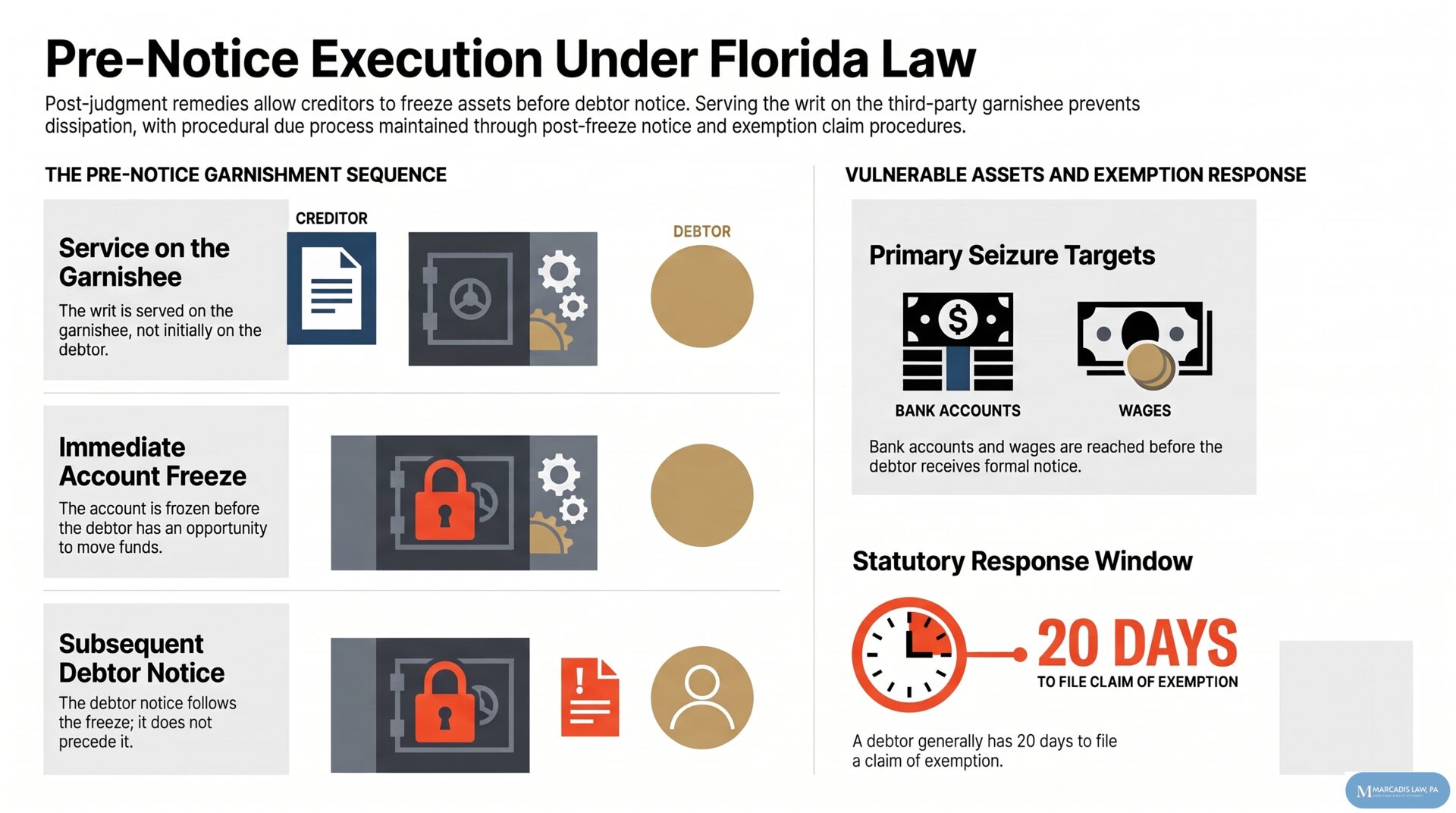
A writ of garnishment issued after judgment under Florida Statutes § 77.03 authorizes the creditor to reach assets held by a third party, most often a bank. The writ is served on the garnishee (the institution holding the funds), not initially on the debtor. When the bank receives the writ, it must hold the funds in accounts subject to the writ pending the court's determination. The debtor receives a copy of the writ, the garnishee's answer, and a notice of rights, but that service follows service on the garnishee. The result: the account is frozen before the debtor has an opportunity to move funds, claim exemptions, or take any protective action. This sequence is statutory, not punitive. It reflects the judgment creditor's legal entitlement to execute on a final judgment and the practical reality that post-judgment debtors, once notified, may withdraw or transfer funds to avoid collection.
When the Levy Occurs Before Debtor Notice
The bank levy does not require advance notice to the debtor. Under Chapter 77, the garnishee, here, the bank, is served first. Upon service, the bank must hold the funds and answer the writ within 20 days, disclosing what funds or property it holds. After the garnishee is served, the creditor serves the debtor with a copy of the writ, the garnishee's answer, and the statutory notice of the debtor's right to claim exemptions required by Florida Statutes § 77.041. The debtor's notice follows the freeze; it does not precede it. This is not a defect. It is the structure that allows creditors rights and debt collection remedies to function without giving the debtor an opportunity to defeat the levy before it takes effect.
Due process does not require that a debtor receive advance warning of every enforcement action. What it requires is notice and an opportunity to be heard at a meaningful time. In the garnishment context, the meaningful time is the window after the freeze, during which the debtor may file a claim of exemption or a motion to dissolve the writ. The freeze itself is provisional, subject to challenge, subject to exemption claims, subject to judicial review. It takes effect immediately because the alternative would render the remedy hollow. Consider a hypothetical: a judgment creditor obtains a writ and notifies the debtor in advance that a bank levy will be executed in five days. The debtor withdraws all funds and transfers them to an account in another person's name. The writ is served on an empty account. The judgment, though valid, becomes uncollectible. Florida law closes that gap by permitting the levy to occur without advance debtor notice, preserving the creditor's ability to reach assets still within the legal process.
Which Assets Are Vulnerable to Immediate Seizure
Bank accounts are the most common target of pre-notice levy because they are held by a third party who can be served with the writ and who has a legal duty to hold the funds upon receipt. Wages are also reached under Chapter 77, through a continuing writ of garnishment against salary or wages, and are subject to the exemption in Florida Statutes § 222.11 for the earnings of a person who provides more than one-half of the support for a child or other dependent. There, too, the writ reaches the employer before the debtor receives formal notice. The sequence is the same: service on the garnishee, withholding of funds, then notice to the debtor with an opportunity to claim an exemption. The difference lies in the type of asset and the exemptions that apply, not in the timing of the levy relative to debtor notice.
Titled personal property subject to replevin under Florida Statutes Chapter 78, such as a vehicle securing a perfected security interest, can also be taken before a full hearing on the merits, provided the creditor satisfies the statutory requirements for a prejudgment writ, including bond, or obtains an order to show cause under the chapter. Real property is not subject to the same immediate seizure. Foreclosure and execution sales involve notice, publication, and sale dates set well in advance, but a judgment lien created by recording a certified copy of the judgment under Florida Statutes § 55.10 attaches to real property in the county of recording without the debtor's consent or advance notice. The lien does not seize the property, but it impairs the debtor's ability to sell or refinance without satisfying the judgment. The attachment is immediate and operates as a practical constraint on the asset.
- Bank accounts held in the debtor's name, frozen upon service of the writ on the financial institution
- Wages, subject to a continuing writ of garnishment served on the employer before notice reaches the employee
- Non-exempt personal property held by third parties, reachable via garnishment of the third-party holder
- Rents and receivables held by tenants or customers, subject to third-party garnishment
- Vehicles and titled goods subject to replevin where the creditor holds a perfected security interest
Exempt assets are not automatically insulated from the initial freeze; in practice they are protected through post-levy claims of exemption. A bank account holding Social Security deposits, earnings of a person who provides more than one-half of the support for a dependent, or other protected funds may still be frozen when the garnishee cannot readily identify the source. The debtor must then file a claim of exemption and, if necessary, request an expedited hearing to release the funds. The burden is on the debtor to establish the exempt character of the funds after the freeze has occurred. A judgment creditor is not obligated to trace the source of every deposit before seeking a writ, although federal regulations do require banks to review certain accounts for directly deposited federal benefits and to protect a limited amount automatically. The framework generally places the risk of an erroneous levy on the debtor, with the remedy being a prompt post-levy exemption claim rather than a pre-levy hearing. An allocation courts have upheld because the deprivation is temporary and followed by prompt process.
The Statutory Framework Governing Pre-Notice Execution
Florida law affords the judgment creditor broad discovery in aid of execution, including examination of the judgment debtor and third parties about the location of assets, and Florida Statutes § 56.29 provides the proceedings supplementary mechanism for reaching assets held by or for the debtor. Discovery, however, does not itself constitute notice of an imminent levy. A debtor examined under oath about bank accounts and income may understand that garnishment is likely, but the creditor is not required to announce the date or target of the levy. Once the information is obtained, the creditor may proceed. Florida Statutes § 77.055 requires the creditor, after the garnishee serves its answer, to mail to the debtor a copy of the answer together with the notice of the debtor's right to move to dissolve the writ, and Florida Statutes § 77.041 governs the exemption notice and claim form. Neither provision contemplates advance warning, because advance warning would defeat the purpose of the writ.
The debtor's remedy is not advance notice; it is the exemption claim process under Florida Statutes § 77.041, which requires the creditor to provide the debtor with a notice of the garnishment and a form for claiming exemptions. The debtor has a limited time to file the claim, 20 days from the mailing of the notice under the statute, and the burden is on the debtor to act. If the debtor does not respond, the garnishment proceeds toward final judgment against the garnishee and the funds are turned over to the creditor. If the debtor does file a claim, the court sets a hearing, and the funds ordinarily remain held until the claim is resolved. The process protects the creditor's interest in preventing dissipation while giving the debtor a post-seizure opportunity to assert rights. The balance is not perfect, but it is the one the legislature has struck, and post-judgment garnishment of this kind has withstood constitutional scrutiny.
What Happens After the Freeze
Once the bank account is frozen, the debtor's options are narrow and time-sensitive. A claim of exemption should be filed promptly, supported by documentation showing the source of the funds and the applicable statutory exemption. Florida Statutes § 222.11 exempts the earnings of an individual who provides more than one-half of the support for a child or other dependent, subject to the statute's conditions and limits; 42 U.S.C. § 407 protects Social Security benefits from garnishment; and Florida law exempts certain public benefits and disability payments. But the exemption is not self-executing in this posture. The debtor must file the claim, obtain a hearing, and prove entitlement. A court may hear the matter on an expedited basis where the debtor shows immediate hardship, but the default timeline can leave funds held for weeks.
If the debtor does not file a claim, the garnishee's answer stands, the amount held is disclosed, and those funds are paid over to the creditor once the court enters final judgment in garnishment. If the debtor files a claim and the court finds the funds exempt, the writ is dissolved as to those funds and they are released. If the court finds the funds non-exempt, the garnishment proceeds and the creditor recovers. The burden throughout is on the debtor to act, to prove, and to pursue relief. The creditor's role is to obtain and serve the writ, deliver the required notices, and wait for either payment or a hearing. The system favors speed and certainty of collection, with procedural safeguards that operate after the levy rather than before it.

The architecture of post-judgment enforcement in Florida is built on the principle that a final judgment is entitled to immediate effect. Pre-notice seizure is not an exception to due process; it follows from a system that treats the judgment as a conclusive determination of the debt and of the creditor's right to satisfy it. The debtor's opportunity to be heard comes after the levy, not before, because the merits were already litigated and the judgment already entered. What remains is execution, and execution requires tools that function before the debtor can move assets beyond reach. The line between lawful enforcement and constitutional violation is not crossed by the timing of the levy. It is crossed only when the debtor is denied a meaningful opportunity to challenge the levy after it occurs. Florida law provides that opportunity, but it places the burden on the debtor to act quickly, and the consequences of inaction are difficult to undo.
Closing Remarks
If your institution holds a Florida judgment and needs to execute before the debtor repositions assets, if a bank levy has been served but the garnishee's answer raises questions of exemption or third-party claims, or if you require a collection process that moves decisively without exposing your name to procedural missteps, the scope of pre-notice enforcement and the timing of levy execution are not questions to leave to chance. Marcadis Law Firm has conducted Florida post-judgment collection at institutional scale for nearly fifty years, recovering what is owed with the discipline that protects both the debt and the relationship. Contact us to discuss your file.
Frequently Asked Questions
Can a bank freeze my account without notifying me first?
Yes. Florida law permits a judgment creditor to serve a writ of garnishment on a bank, and the bank must then hold the funds subject to the writ before the account holder receives notice. The debtor is served with a copy of the writ, the garnishee's answer, and notice of exemption rights after service on the bank, but the hold takes effect when the financial institution is served. The debtor's remedy is to file a claim of exemption or move to dissolve the writ after the freeze occurs, not to receive advance warning that would allow the funds to be moved.
What types of assets can be seized before I am notified?
Bank accounts, wages subject to a continuing writ of garnishment, rents, accounts receivable, and certain personal property held by third parties can all be reached through garnishment served on the third party before the debtor receives notice. Real property cannot be seized in the same immediate fashion, but a judgment lien created by recording a certified copy of the judgment attaches without advance notice and encumbers property in that county from the date of recording. Titled property subject to replevin can be taken pursuant to a writ, though bond and the statutory procedures of Chapter 78 must be followed.
How much time do I have to respond after a levy occurs?
After the notice of garnishment and claim-of-exemption form are served, a debtor generally has 20 days to file a claim of exemption under Florida Statutes § 77.041. If the debtor claims that the funds or property are exempt, the court will set a hearing, and the funds ordinarily remain held until the claim is resolved. Acting quickly is essential; failure to file a timely claim can result in the funds being paid over to the creditor upon final judgment in garnishment.
Is it legal for a creditor to freeze funds without a court hearing first?
Yes. Post-judgment garnishment does not require a pre-deprivation hearing because the underlying debt was already adjudicated with full due process. The creditor has obtained a final judgment establishing the debt. Execution remedies, including garnishment, are authorized by statute and do not require an additional hearing before the writ issues and is served. The debtor's due process protection is the opportunity to challenge the garnishment and assert exemptions after the freeze, not a right to a hearing before enforcement begins.
What happens if exempt funds are frozen by mistake?
If exempt funds, such as Social Security benefits, the earnings of a person providing more than one-half of the support for a dependent, or other protected income, are frozen, the debtor should file a claim of exemption with documentation establishing the exempt character of the funds. The court will hold a hearing, and if the debtor proves the exemption applies, the writ will be dissolved as to those funds and they will be released. A judgment creditor is not required to trace the source of every deposit before seeking a writ, though federal rules require banks to review accounts for directly deposited federal benefits and protect a limited amount automatically. Delay in filing can prolong the loss of access to funds even when they are ultimately determined to be exempt.
References
- Florida Statutes § 55.10 (Judgments, Orders, and Decrees; Lien on Real or Personal Property).
- Florida Statutes § 56.29 (Proceedings Supplementary).
- Florida Statutes Chapter 77 (Garnishment).
- Florida Statutes § 77.03 (Issuance of Writ After Judgment).
- Florida Statutes § 77.041 (Notice to Individual Defendant for Claim of Exemption from Garnishment; Procedure for Hearing).
- Florida Statutes § 77.055 (Service of Garnishee's Answer and Notice of Right to Dissolve Writ).
- Florida Statutes Chapter 78 (Replevin).
- Florida Statutes § 222.11 (Exemption of Wages from Garnishment).
- 42 U.S.C. § 407 (Assignment of Benefits).