
TL;DR: Bank levies freeze account funds immediately, but Florida law and federal benefit protections provide narrow pathways for early release based on exemption status, source tracing, and hardship. Understanding which funds qualify for release, and what procedural requirements apply, shapes whether frozen balances remain inaccessible or become available before the garnishment concludes.
A bank levy strikes with precision. One moment an account operates normally; the next, balances freeze and access disappears. For creditors,that seizure is the culmination of months of work: judgment obtained, debtor located, writ issued. But the freeze is not always final. Florida law and federal protections carve out exceptions that permit certain funds to be released before the garnishment runs its course. These exceptions are not automatic. Theyrequire documentation, procedural compliance, and, often, speed. The difference between funds that remain frozen and funds released early turns on what the money is, where it came from, and whether the debtor moves before the opportunity closes.

Understanding which frozen funds may qualify for early release, and under what conditions, matters to creditors who need to assess the durability of a levy and to institutional clients whose customers invoke exemption claims. The framework is statutory, the timelines are short, and the outcomes depend on proof.
Exempt Funds and the Statutory Framework
Florida law does not protect all bank account funds from levy. But certain categories of deposits carry exemption status by statute or federal law, and those exemptions survive the levy if properly claimed. The most common sources of exempt funds include:
- Social Security benefits under 42 U.S.C. § 407(a)
- Veterans' benefits under 38 U.S.C. § 5301
- Supplemental Security Income (SSI) payments
- Railroad Retirement benefits
- Head-of-household wages under Florida Statutes § 222.11, when deposited and identifiable
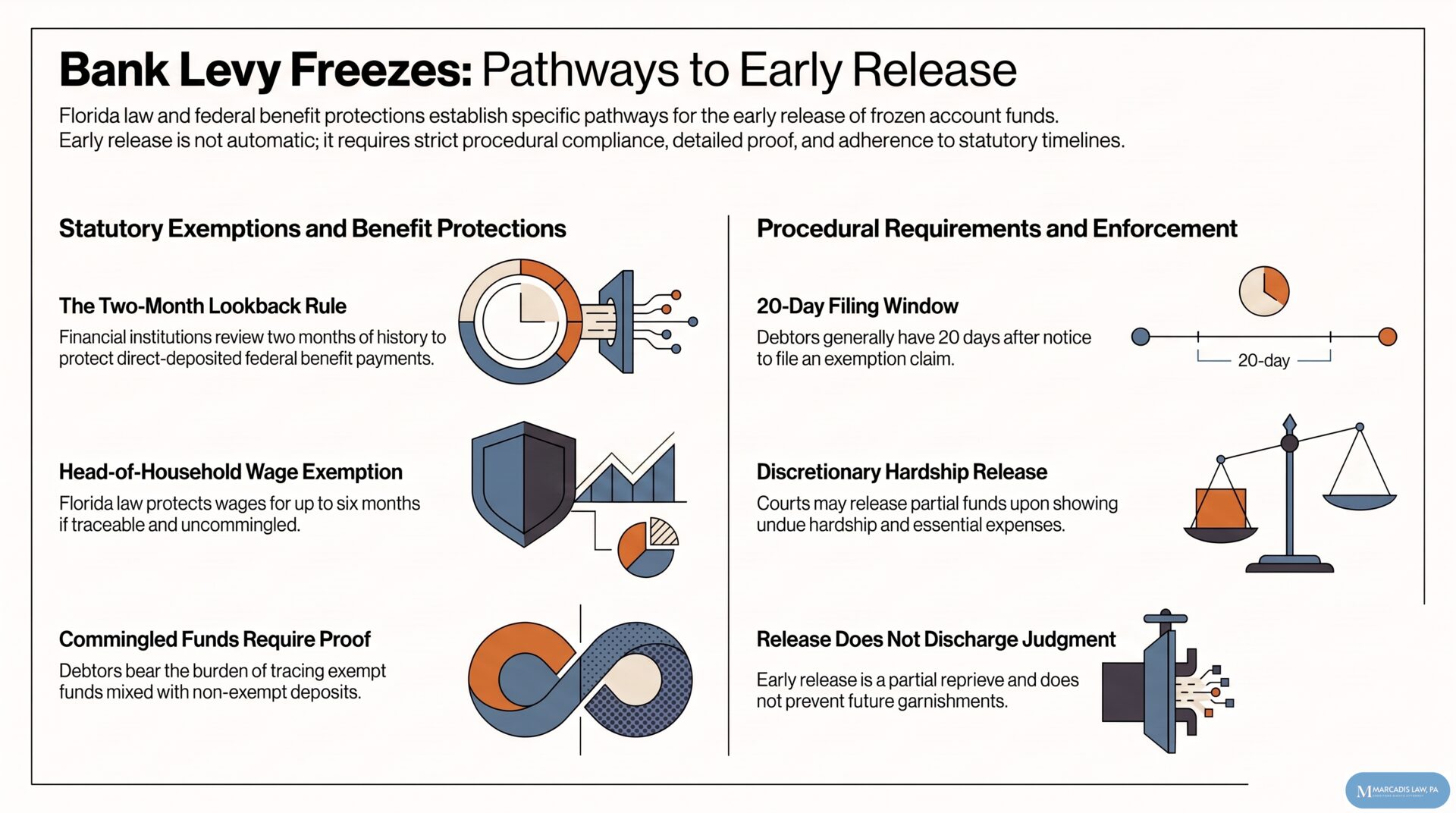
Federal law prohibits garnishment of Social Security and certain other benefit payments. When those funds are direct-deposited into a bank account, financial institutions are required under 31 C.F.R. Part 212 to apply a two-month lookback to calculate a protected amount and shield that sum from garnishment. This "protected amount" is not a debtor election; it is a federal mandate that operates before any claim of exemption is filed.
Head-of-household wages present a more complex scenario. Under Florida Statutes § 222.11, wages paid to a head of family are exempt from garnishment, and that protection can extend to wages deposited in a financial institution for up to six months after receipt, but only if the funds remain traceable and are not commingled with other funds. The exemption must be affirmatively claimed, and the burden of tracing falls on the debtor.
Procedural Requirements for Early Release
Exempt status alone does not release funds. The debtor must act. Florida Statutes § 77.041 sets the process: a claim of exemption and request for hearing must be filed with the court and a copy served on the creditor and the garnishee, generally within 20 days after the debtor receives the required notice. The claim should identify the exempt funds, specify the legal basis for the exemption, and be supported by documentation: benefit award letters, deposit records, pay records showing head-of-family status.
Once a claim of exemption is filed, the creditor may contest it. If contested, a hearing follows. If the claim is not contested within the time allowed by statute, or if the court sustains the exemption after hearing, the court directs release of the exempt portion of the frozen account. Until that order issues, the funds remain frozen.
Speed determines outcome. Debtors who delay filing lose access to funds that may otherwise qualify. Creditors who receive an exemption claim must evaluate the documentation promptly, whether the funds are genuinely exempt, whether tracing is adequate, and whether a contest is warranted. For institutional creditors, creditors rights and debt collection processes that involve garnishment of accounts receiving federal benefits require awareness of these timelines and the federal protections that apply automatically.
The Two-Month Lookback Rule
Under 31 C.F.R. § 212.5, a financial institution served with a garnishment order must review the account history for the two months preceding the account review to identify protected federal benefit deposits. The institution calculates the lesser of the sum of those benefit payments or the balance in the account and protects that amount, even if it is commingled with other funds. This figure is the "protected amount," and the institution must keep it accessible to the account holder rather than turning it over to the garnishing creditor.
This rule operates independently of any debtor claim. The bank performs the account review, notifies the account holder, and may freeze and ultimately turn over funds above the protected amount in accordance with the garnishment order and applicable state procedure. For creditors, this means that garnishment proceeds from accounts receiving federal benefits may be reduced or eliminated before the debtor ever appears in court.
Commingled Funds and the Burden of Tracing
Commingling erodes exemptions. When exempt funds, wages, benefits, or other protected income, are deposited into an account that also receives non-exempt deposits, the exemption does not automatically extend to the entire balance. Florida courts require clear tracing to establish which portion of the account balance derives from exempt sources.
Consider a hypothetical: an account receives a $1,200 Social Security deposit on the first of the month and a $500 non-exempt payment from a side business on the fifteenth. A writ is served on the twentieth, freezing a balance of $1,400. The federal account review protects an amount equal to the Social Security benefits deposited in the lookback period, up to the account balance, but the account also contains non-exempt funds. If the debtor cannot demonstrate that the remaining balance consists of protected deposits, through bank statements, deposit codes, or sequential tracing, the exemption claim as to that remainder weakens. Courts do not presume exempt status; they require proof.
This burden falls hardest on debtors who use a single account for all income. For creditors, commingled accounts increase the likelihood that some portion of the garnishment will survive an exemption challenge, even if part of the balance is ultimately released.
Hardship and Discretionary Release
Beyond statutory exemptions, Florida courts have, in limited circumstances, entertained requests to release frozen funds on hardship grounds. This is not an independent statutory right; it is an equitable request addressed to the court's discretion, typically raised where continued freezing of funds would work an undue hardship and the debtor shows that no other means of meeting essential expenses exist.
Such motions face a demanding record. Courts generally expect detailed financial affidavits, proof of essential expenses (rent, utilities, medical costs), and evidence that the frozen funds are the only available resource. Even when relief is granted, it is typically partial: enough to address the immediate need, not enough to defeat the garnishment entirely. Creditors confronting a hardship motion should scrutinize the supporting affidavit for accuracy, review the debtor's other assets, and assess whether the hardship is genuine or a tactical delay.
Hardship release does not extinguish the underlying judgment. It delays collection and may reduce the proceeds, but the judgment remains enforceable and the creditor retains its post-judgment remedies. The question is whether the immediate release serves the debtor's legitimate needs or merely dissipates an asset that would otherwise satisfy the debt.
Timing and Tactical Considerations
The clock starts when the writ of garnishment is served on the financial institution. The institution freezes the account, the required notices go out, and any federally protected amount is calculated. The debtor then has a narrow window, generally 20 days after receiving notice of the right to claim an exemption, to file a claim of exemption and request a hearing. Once that period expires without action, the frozen funds may be turned over to the garnishing creditor pursuant to court order.
For creditors, this window is an opportunity to verify the debtor's claims before funds are released. Documentation should be requested and scrutinized. Deposit history, benefit award letters, employer records reflecting head-of-family status, all are subject to challenge. A creditor who contests a weak exemption claim early can preserve the garnishment. A creditor who allows an unsupported claim to proceed unopposed may lose funds that are never recovered.
What Early Release Does Not Mean
Early release of frozen funds does not discharge the judgment. It does not prevent future garnishments. It does not immunize the debtor from other post-judgment enforcement tools; continuing writs of garnishment against salary or wages under Florida Statutes § 77.0305, proceedings supplementary and debtor examinations under § 56.29, or levy and execution against non-exempt assets. Release means only that a particular sum, from a particular account, at a particular moment, falls outside the creditor's immediate reach.
A Florida judgment creates a lien and remains enforceable for twenty years under Florida Statutes § 55.081, subject to the recording and re-recording requirements that govern judgment liens on real and personal property. Post-judgment interest continues to accrue. The creditor may garnish other accounts, pursue other assets, and return to the same account once new non-exempt deposits arrive. Early release is a partial reprieve, not a final resolution.

For institutional creditors, the framework matters because it shapes expectations, informs decisions about whether to contest exemption claims, and defines what portion of a garnishment is likely to survive challenge. A levy on an account receiving only Social Security benefits will yield little. A levy on an account with commingled deposits may yield much of the balance if the debtor cannot meet the tracing burden. The calculus depends on the facts, the documentation, and the speed with which each side moves.
Closing Remarks
If your institution is managing garnishment proceeds subject to exemption claims, evaluating whether commingled accounts support early release, or deciding whether to contest a debtor's hardship motion, the outcome turns on documentation, timing, and familiarity with both Florida exemption statutes and federal benefit protections. Marcadis Law Firm represents creditors and judgment holders in post-judgment enforcement matters across Florida, including contested garnishments and exemption disputes. Contact us to discuss your enforcement strategy, handled with the discipline the work demands and the restraint your customer relationships require.
Frequently Asked Questions
Can a debtor get frozen funds released without filing a formal exemption claim?
Generally only where the funds fall under the federal account-review rules in 31 C.F.R. Part 212. In that case, the financial institution calculates and protects a sum tied to federal benefit deposits received in the two-month lookback period, and that protected amount is kept accessible to the account holder rather than turned over to the creditor. For other exemptions, head-of-family wages or other statutory protections, the debtor must file a claim of exemption with the court and serve it as the statute requires. Without that filing, frozen funds may be turned over once the statutory period expires.
How long does the debtor have to file a claim of exemption after a bank levy?
Under Florida Statutes § 77.041, the debtor generally has 20 days after receiving the statutory notice of the right to claim an exemption to file a claim of exemption and request a hearing. Missing that deadline can result in the frozen funds being turned over to the creditor. Speed is essential. Once the claim is filed, the creditor may contest it, and a hearing follows. If the claim is uncontested or sustained, the court directs release of the exempt portion.
What happens if exempt and non-exempt funds are mixed in the same account?
Commingling weakens the exemption. Florida courts require the debtor to trace which portion of the account balance derives from exempt sources, Social Security, head-of-family wages, or other protected income. Without clear tracing through bank statements and deposit records, the debtor may be unable to establish that the balance is exempt beyond any federally protected amount. The burden is on the debtor. Creditors facing commingled-account exemption claims should request detailed documentation and address vague or unsupported assertions of exempt status.
Can a creditor challenge an exemption claim after funds have been released?
Once the court orders release of exempt funds and the financial institution complies, reversing that release is difficult. The time to challenge is before the order issues, promptly after the debtor files the exemption claim. Creditors should review the claim and supporting documents quickly, file a response identifying deficiencies in tracing or statutory eligibility, and be prepared for a hearing. Delay costs leverage. After release, the creditor's practical options narrow considerably and may require showing that the exemption was claimed on false grounds, which demands clear evidence.
Does early release of frozen funds prevent future garnishments on the same account?
No. Release of exempt funds in one garnishment does not immunize the account from future enforcement. The judgment remains valid and enforceable. If new non-exempt deposits arrive, wages that do not qualify for head-of-family protection, business income, or other funds, the creditor may obtain a new writ of garnishment. Exemption determinations are specific to the funds and the moment of service, not permanent account-wide protections. Each garnishment is evaluated based on the account balance and deposit sources at the time the writ is served.
References
- 31 C.F.R. Part 212 ((Garnishment of Accounts Containing Federal Benefit Payments), including §§ 212.3, 212.5, 212.6).
- 38 U.S.C. § 5301
- 42 U.S.C. § 407
- Florida Statutes § 55.081
- Florida Statutes § 56.29
- Florida Statutes § 77.0305
- Florida Statutes § 77.041
- Florida Statutes § 222.11
- 31 C.F.R. § 212.5
- 42 U.S.C. § 407(a)