
TL;DR: When a judgment lien attaches to a debtor's property in Florida, priority determines which creditor gets paid first if the asset is sold or liquidated. Priority is generally established by the chronological order of recording, but Florida and federal law create specific exceptions for purchase-money mortgages, tax liens, construction liens, and association assessments that can outrank a judgment lien even when the competing interest arises later.
A judgment without collection is a paper promise. The lien converts that promise into a claim against property, but not all liens are created equal. When multiple creditors have recorded claims against the same asset, the order in which they are paid is not a negotiation. It is a matter of statute and sequence, and the creditor who assumes priority based solely on the date stamped at the courthouse may find that assumption was expensive.

Priority is the architecture of enforcement. In Florida, judgment liens do not automatically override every other claim on a debtor's property. Instead, they fit into a hierarchy shaped by recording dates, statutory exceptions, and the nature of competing interests. Understanding what attaches first, and what a judgment lien cannot displace, is essential to calculating the real recovery value of a debtor's assets before time and expense are committed to execution.
How Judgment Liens Attach Under Florida Law
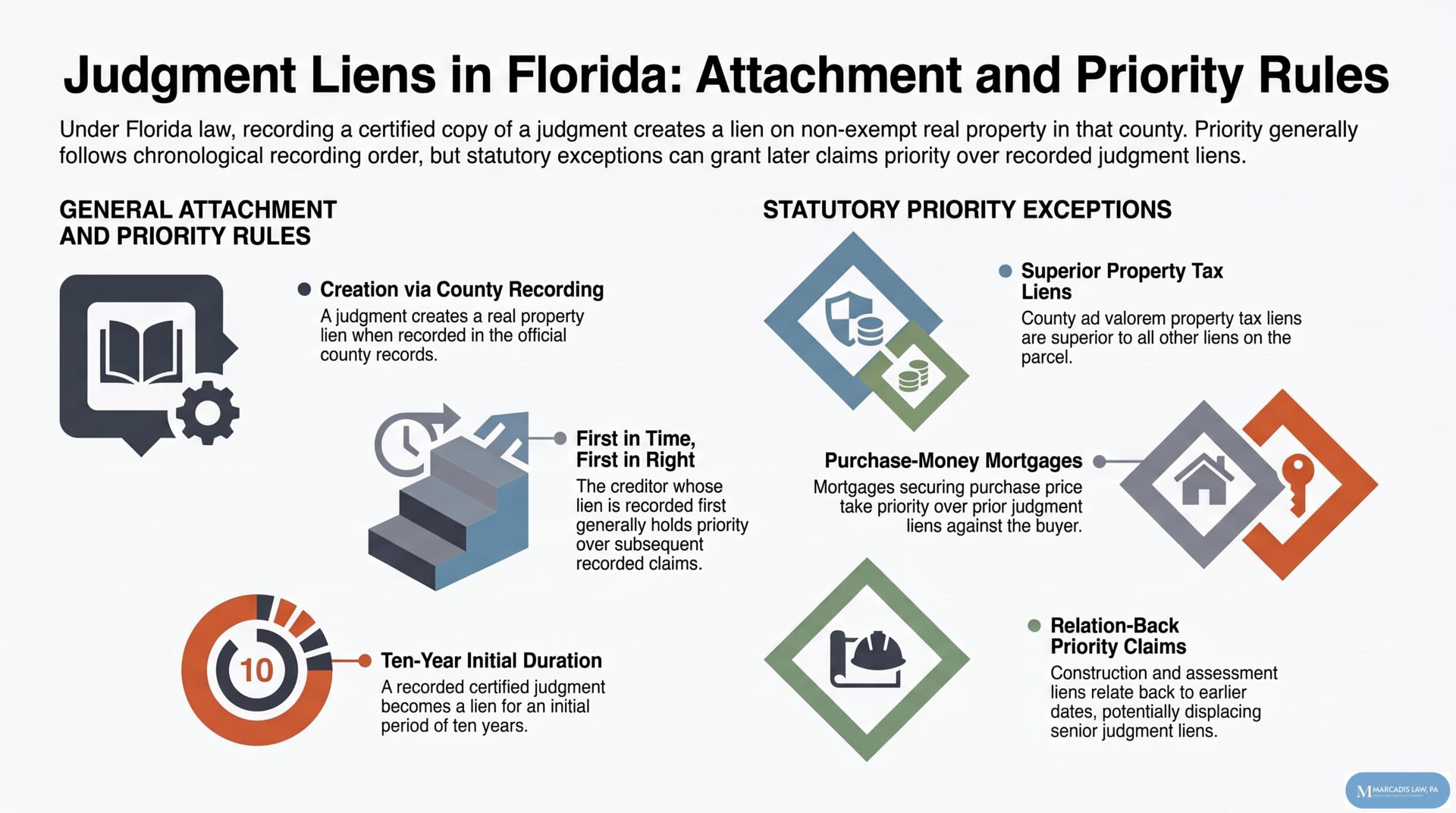
A judgment lien in Florida is created under Florida Statutes § 55.10 when a certified copy of a judgment is recorded in the official records of the county where the debtor owns real property. The lien attaches to all non-exempt real property the debtor owns in that county at the time of recording, and to any real property the debtor acquires in that county while the judgment remains enforceable.
The lien does not attach to homestead property protected under Article X, Section 4 of the Florida Constitution, nor does it attach to property held as tenancy by the entireties when the judgment is against only one spouse and does not arise from a jointly incurred debt. The lien is a general encumbrance; it does not give the judgment creditor possession or control, but it creates a recorded interest that must be addressed before clear title can pass.
Recording is what converts the judgment into a lien on real property. Without recording in the county where the property is located, the judgment remains enforceable but does not encumber the real estate. Under Florida Statutes § 55.10, a recorded certified copy of a judgment becomes a lien for an initial period of ten years from the date of recording, and that period may be extended for an additional ten years by re-recording a certified copy of the judgment before the initial period expires. That lien period operates within the twenty-year life of the judgment itself under Florida Statutes § 95.11, so a creditor who intends to preserve a lien must track both the recording deadline and the underlying enforceability of the judgment.
General Rule: First in Time, First in Right
The foundational principle governing lien priority in Florida is simple: first in time, first in right. The creditor whose lien is recorded first generally has priority over all liens recorded after it. This rule applies neutrally across judgment liens, mortgages, and other recorded encumbrances.
Consider a hypothetical: a judgment creditor records a certified judgment in Orange County on March 1. Another creditor records a separate judgment lien on the same property on April 15. If the property is sold or foreclosed, the March 1 lien is satisfied first from the proceeds. The April 15 creditor receives payment only if proceeds remain after the senior lien is paid in full. If the sale generates insufficient funds to satisfy both liens, the junior lienholder may recover nothing.
The recording date and time are noted by the clerk when the instrument is accepted into the official records. That sequence controls priority. Minutes can matter. A judgment lien recorded at 10:00 a.m. generally has priority over one recorded at 10:15 a.m. on the same day, assuming both are otherwise valid and properly indexed.
This chronological rule is mechanical and unforgiving. It rewards the creditor who moves promptly after obtaining judgment and who ensures the lien is recorded in every county where the debtor holds real property. Delay erodes priority, and priority determines recovery.
Statutory Exceptions: Liens That Jump Ahead
Florida and federal law carve out specific exceptions to the first-in-time rule, granting superior priority to certain categories of liens without regard to ordinary recording sequence. A judgment creditor evaluating the recovery value of real property must account for these priorities, because they dictate the order in which competing claims are satisfied at sale.
- Property Tax Liens: County ad valorem property tax liens are superior to all other liens on the parcel, including a previously recorded judgment lien, and must be satisfied first from sale proceeds.
- Federal Tax Liens: A federal tax lien is governed by 26 U.S.C. § 6323. A judgment lien that qualifies as a judgment lien of a "judgment lien creditor" and is perfected before the IRS files its notice of federal tax lien generally has priority; a judgment lien perfected after that notice is filed is subordinate to the federal tax lien.
- Purchase-Money Mortgages: A mortgage given to secure the purchase price of real property generally takes priority over a judgment lien of record against the buyer, because the judgment creditor had no claim to equity in property the debtor did not yet own and to value created by the purchase-money loan itself.
- Construction Liens: Liens arising under Florida Statutes Chapter 713 for labor, services, or materials furnished to improve real property attach and take priority as of the date the notice of commencement is recorded, or, if none, from the time the claim of lien is recorded. That relation-back feature can give a properly perfected construction lien priority over a judgment lien recorded after the notice of commencement. The analysis is limited and fact-intensive, but it can displace an apparently senior judgment lien.
- Homeowners' Association and Condominium Liens: Liens for unpaid assessments under Florida Statutes §§ 720.3085 and 718.116 relate back to the recording of the governing declaration, which generally places them ahead of later-recorded judgment liens. Those statutes also limit the amount a first mortgagee taking title must pay, which is a separate question from priority as against a judgment creditor.
These exceptions are not loopholes. They are deliberate policy choices embedded in Florida and federal law. A judgment lien does not operate in a vacuum. Its practical value is constrained by competing interests that the legislature and Congress have chosen to elevate. A creditor who assumes that recording first guarantees payment first may discover too late that an exception has displaced that assumption, and that the debtor's equity has already been consumed by a senior claim.
Mortgages and Priority After Refinancing
A mortgage recorded before a judgment lien takes priority over that lien. This is a straightforward application of the first-in-time rule. If a debtor's property is encumbered by a mortgage recorded in 2018, and a judgment lien is recorded in 2023, the mortgage is senior. At foreclosure sale, the mortgage is satisfied first, and the judgment creditor receives proceeds only if the sale price exceeds the mortgage balance plus costs.
The analysis becomes more complex when the debtor refinances or takes out a second mortgage after the judgment lien is recorded. A refinance that pays off the original senior mortgage and replaces it with a new loan does not automatically preserve the priority of the original mortgage. The new mortgage is generally treated as a separate instrument recorded after the judgment lien, and the judgment lien may advance in position unless priority is preserved through a recorded assignment, a subordination agreement, or an equitable subrogation claim recognized by a Florida court.
Subordination agreements and intercreditor agreements can reorder priority by contract, but only among parties who consent, and they should be properly recorded to bind subsequent purchasers and lienholders. A judgment creditor is not bound by a subordination it did not agree to. If the debtor and another lienholder attempt to reorder priority without the judgment creditor's consent, the judgment lien's position remains intact.
Liens on Personal Property: A Separate Framework
Recording a judgment under Florida Statutes § 55.10 creates a lien on real property only; it does not by itself encumber the debtor's personal property. To reach a debtor's personal property, bank accounts, equipment, vehicles, inventory, a judgment creditor must use post-judgment remedies such as garnishment, a writ of execution and levy, or the other creditors' rights and debt collection tools that reach specific assets through court process.
Florida also provides a statewide judgment lien on most business personal property through the filing of a judgment lien certificate with the Florida Department of State under Florida Statutes § 55.202 through § 55.209. Priority among competing judgment lien certificates is determined by the order of filing, and a properly perfected consensual security interest in the same collateral will generally outrank a later judgment lien. For titled personal property such as vehicles and vessels, a lender that financed the purchase will typically appear as a lienholder on the certificate of title, and that perfected security interest takes priority over a judgment creditor's later claim to the same asset.
Security interests in other personal property are governed by the Uniform Commercial Code as adopted in Florida under Chapter 679 of the Florida Statutes. A creditor with a perfected UCC security interest in business assets: inventory, accounts receivable, equipment, generally has priority over a judgment creditor's later attempt to levy on those same assets. Perfection is most often accomplished by filing a UCC-1 financing statement with the Florida Department of State. A writ of execution does not override a security interest that was properly perfected before the judgment creditor's lien arose.
Effective enforcement, including bank account levies after garnishment, depends on early identification of which assets are already encumbered and which remain reachable under Florida's priority rules.
Sale Proceeds and the Waterfall of Distribution
When property encumbered by multiple liens is sold, whether through voluntary sale, foreclosure, or execution sale, the proceeds are distributed in order of priority. A junior lienholder is not paid until senior claims are satisfied. The distribution generally follows this sequence:
- Costs of sale, including clerk's fees, documentary stamps, and attorney's fees where allowed by statute or contract
- Superior statutory claims, such as unpaid ad valorem property taxes
- Senior consensual and judgment liens in order of priority, starting with the earliest-perfected encumbrance
- Junior liens in order of priority
- Any remaining surplus to the debtor or other parties entitled to claim it
If the sale price is insufficient to pay all claims, junior lienholders receive nothing from the sale, and a junior lien can be foreclosed out of the property. The underlying judgment generally remains enforceable, so the creditor must look to other assets or remedies to collect the balance. This outcome is common when property values decline or when senior debt has grown through accrued interest and fees.
Before initiating an execution sale or foreclosure on property encumbered by a senior mortgage or tax lien, a judgment creditor should obtain a title search and payoff statements from all senior lienholders. If the debtor's equity, fair market value minus senior debt, is insufficient to cover the judgment and costs of sale, proceeding to sale may be uneconomical. The property may sell for less than the senior lien balance, leaving no proceeds to reach the judgment lien.
In some cases, purchasing the senior lien or negotiating a discounted payoff can make sense if the property's value justifies the additional investment. But acquiring a senior position is itself a strategic decision, not a routine step. It requires calculation of the asset's liquidation value, an assessment of competing claims, and a realistic projection of net recovery. Priority is not only a legal question; it is a financial one.

Priority determines payment. A judgment lien is only as valuable as its position in the queue, and that position is generally fixed at the moment of recording, subject to the exceptions and competing interests that Florida and federal law elevate above chronological order. Effective enforcement requires mapping the entire lien structure before committing time and cost to collection. The creditor who moves first does not always finish first, but the creditor who understands the priority rules moves with clarity instead of assumption.
Closing Remarks
If a judgment lien has been recorded but recovery depends on a senior mortgage, a statutory exception, or an honest assessment of whether the debtor's equity justifies execution, the priority rules determine what can be collected and at what cost. Marcadis Law Firm has enforced Florida judgments for institutional creditors for nearly fifty years, mapping lien structures and executing on real and personal property with the discipline that separates recovery from expensive motion practice. Contact us to assess the priority position of your claim and build an enforcement strategy grounded in Florida's statutory framework. This article is general information about Florida law and is not legal advice for a specific matter.
Frequently Asked Questions
Does recording a judgment lien in multiple Florida counties create multiple liens with different priority dates?
Yes. Each county maintains its own official records, and a recorded judgment creates a lien only on real property located in the county of recording. If a debtor owns real property in Orange, Seminole, and Brevard counties, the judgment creditor must record a certified copy of the judgment in each county to create a lien on the property located there. Each recording is dated separately, and priority in each county is measured from that county's recording. A judgment recorded in Orange County on March 1 and in Seminole County on March 10 may therefore hold different priority positions in each county if competing liens were recorded between those dates.
Can a judgment lien recorded before a homestead exemption is claimed take priority over the exemption?
No. The homestead protection from forced sale under Article X, Section 4 of the Florida Constitution is self-executing and does not depend on the debtor filing a claim or declaration for creditor-protection purposes. If the property qualifies as homestead, a general judgment creditor's recorded judgment does not create an enforceable lien against it, and the protection is not defeated by the timing of the recording. The Constitution recognizes limited exceptions, including obligations for property taxes and assessments, obligations contracted for the purchase, improvement, or repair of the property, and certain labor obligations, but a general judgment creditor cannot force the sale of protected homestead property regardless of when the judgment was recorded.
What happens to judgment lien priority if the senior lienholder releases its claim?
When a senior lien is satisfied and released, the remaining liens move up in the queue in their existing order. If a property is encumbered by a mortgage recorded in 2018, a judgment lien recorded in 2023, and a second judgment lien recorded in 2024, and the mortgage is paid off and released in 2025, the 2023 judgment lien becomes the senior encumbrance. The release does not alter the relative priority of the remaining liens. The same principle applies where a senior lien is partially released or subordinated by recorded agreement, subject to the terms of that agreement.
Can a judgment lien reach property the debtor acquires after the judgment is recorded?
Yes, but only in a county where the certified copy of the judgment has already been recorded and the lien remains effective. A judgment recorded in Hillsborough County attaches to non-exempt real property the debtor later acquires in Hillsborough County while the lien is in effect. It does not reach property acquired in a different county unless a certified copy of the judgment is recorded there as well. The attachment is continuous; the creditor does not need to record again each time the debtor acquires property in that county, but the creditor must monitor the lien's ten-year term and record in every county where the debtor holds or acquires real estate.
Does a judgment lien take priority over a construction lien recorded after the work is complete?
It depends on the timing of the notice of commencement. Under Florida Statutes Chapter 713, a construction lien attaches and takes priority as of the recording of the notice of commencement, even though the claim of lien itself may not be recorded until months later. If a judgment lien is recorded after the notice of commencement, a properly and timely perfected construction lien may be senior to it. The analysis is fact-specific and requires examining the notice of commencement, the dates of first labor or materials, the recording date of the judgment lien, and the timeliness of the claim of lien. These disputes often require review of notices to owner, contracts, and project records.
Can a creditor with a junior judgment lien force a sale if the debtor's equity will not cover the senior liens?
Often yes, but it is rarely practical. A junior lienholder may pursue execution even when the anticipated proceeds will not reach its lien, but doing so serves little purpose unless there is strategic value: clearing title, or prompting the debtor or a senior creditor to act. Proceeds are distributed in order of priority, and if senior claims consume the available funds, the junior creditor receives nothing while still bearing the costs of sale. Before forcing a sale, the junior lienholder should calculate net equity and weigh whether post-judgment remedies aimed at other assets are more likely to produce a recovery.
References
- Florida Statutes § 55.10 ((judgment lien on real property; ten-year term; re-recording).
- Florida Statutes §§ 55.202–55.209 (judgment lien on personal property; judgment lien certificate).
- Florida Statutes § 95.11 ((limitations period on actions on a judgment).
- Florida Constitution, Article X, Section 4 (homestead exemption from forced sale).
- 26 U.S.C. § 6323 ((priority of federal tax liens over judgment lien creditors).
- Florida Statutes Chapter 713 ((construction liens; priority and notice of commencement).
- Florida Statutes § 718.116 ((condominium assessment liens).
- Florida Statutes § 720.3085 ((homeowners' association assessment liens).
- Florida Statutes Chapter 679 ((Uniform Commercial Code, Secured Transactions).
- Florida Statutes Chapter 197 ((ad valorem property tax liens and their superiority).
- Article X, Section 4 of the Florida Constitution
- Florida Statutes §§ 55.202–55.209